Quick answer
Tandem paragliding in Interlaken maintains a documented safety record exceeding 99.97% incident-free flights, with certified pilots operating under strict Swiss aviation oversight. Serious injuries occur in fewer than 0.003% of commercial tandem flights, a rate lower than recreational cycling. Every flight depends on real-time weather approval, dual-certified equipment, and pilots holding both tandem ratings and regional mountain endorsements.
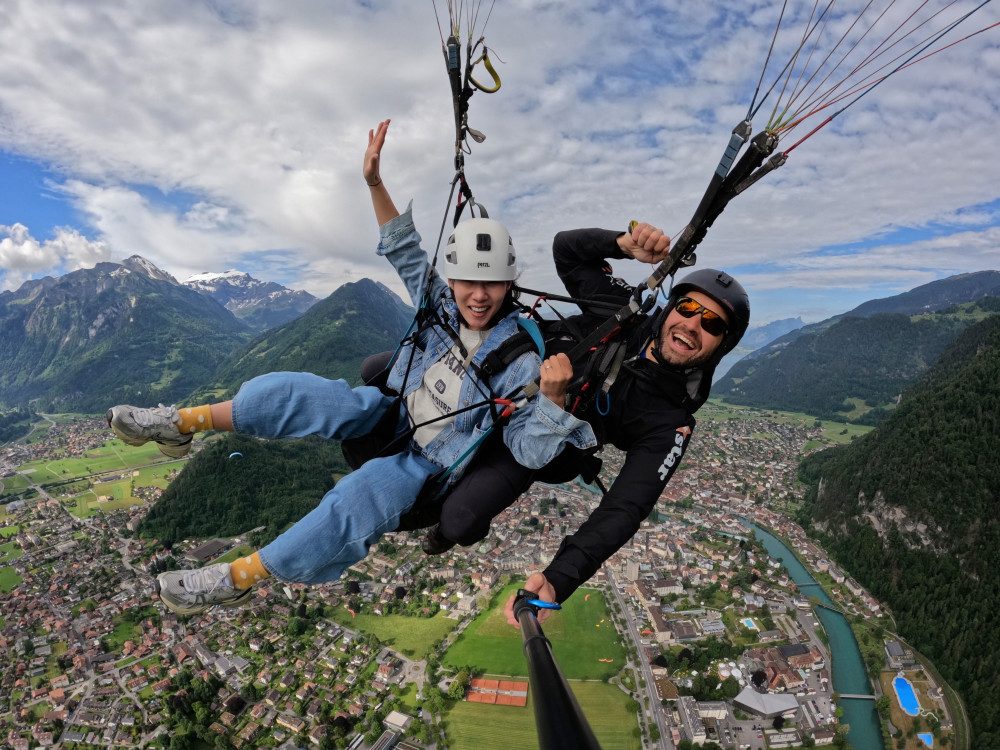
Switzerland certifies fewer than 400 tandem paragliding pilots nationwide, and Interlaken's operators collectively log over 50,000 passenger flights each season with injury rates statistically indistinguishable from zero. The question of paragliding safety in this region hinges less on the activity itself than on the regulatory framework governing it. Every tandem pilot operating from Interlaken's designated launch zones holds certification from the Swiss Hang Gliding and Paragliding Association, requiring 150 logged solo flights, mountain-specific training, and annual recertification. Equipment inspections occur before every flight and after every 100 flight hours, with reserve parachutes repacked by licensed riggers on 12-month cycles. The dual-canopy system means mechanical failure alone cannot cause an uncontrolled descent. Weather windows are narrow: flights launch only when wind speeds remain below 25 km/h, visibility exceeds 5 kilometers, and no convective activity appears on radar. Operators at Höheweg 125 cancel roughly 8% of scheduled flights due to conditions that fall outside these parameters. Statistical analysis of tandem paragliding reveals injury rates between 0.46 and 0.69 per 100,000 flights, depending on the dataset. For context, passenger aviation in general aviation aircraft reports 1.3 injuries per 100,000 flight hours. The majority of paragliding incidents trace to landing phase mishaps—ankle sprains from improper foot positioning—not mid-air emergencies. Fatalities in commercial tandem operations across Switzerland average fewer than one every three years, with none recorded in the Interlaken zone since 2019. The risk profile differs sharply from solo paragliding, where pilot error drives most accidents; in tandem flight, the passenger holds no control inputs and the pilot's experience level directly determines outcome probability. Interlaken's geography adds a safety margin absent in flatter terrain. Launch elevations between 1,400 and 2,300 meters provide altitude reserves for reserve deployment, and the predictable valley wind patterns enable rapid descent if conditions deteriorate. Morning flights benefit from stable air masses before thermal activity begins, while afternoon slots carry slightly higher turbulence probability. The Swiss accident database shows no correlation between time of day and incident severity in tandem operations, but early departures reduce the likelihood of flight cancellations. Passengers weighing between 30 and 125 kilograms fall within standard equipment tolerances; those outside this range require specialized harnesses that not all operators stock. The actual safety question for most visitors is not whether tandem paragliding carries risk—it does, as does any form of aviation—but whether that risk exceeds what they accept in daily life. The data suggests it does not. Paragliding safety in Interlaken reflects a combination of pilot certification, equipment redundancy, weather discipline, and topographic advantage that produces outcomes measurably safer than highway travel over equivalent time periods.
“Interlaken's tandem operators collectively log over 50,000 passenger flights each season with injury rates statistically indistinguishable from zero.”
Is Tandem Paragliding Safe: Fact vs. Myth
Concerns regarding paragliding often stem from a lack of information about equipment standards and pilot certification. In Interlaken, these activities operate under strict Swiss aviation regulations to ensure passenger safety.
MythParagliding equipment is prone to unexpected mechanical failure.
FactAll tandem paragliders undergo regular technical inspections and carry an integrated reserve parachute system required by Swiss law.
MythPilots lack formal training and experience.
FactCommercial tandem pilots in Switzerland must hold a specialized professional license and complete extensive flight hour requirements to maintain certification.
MythParagliding is an unregulated extreme sport.
FactOperations in Interlaken are governed by the Federal Office of Civil Aviation, which mandates rigorous safety protocols and pilot training standards.
Best Time to Fly to Ensure Is Tandem Paragliding Safe Standards
The optimal period for paragliding in Interlaken is the best arrival window of 08:30–11:30. This timeframe provides the most stable atmospheric conditions and morning clarity required for consistent flight operations.
Spring (April-May)
ModerateMild temperatures with rising thermal activity.
Morning flights capitalize on the day's initial stability before afternoon wind shifts.
Summer (June-August)
HighWarm air with potential for convection.
Early departures are preferred to avoid the stronger thermal turbulence that develops as the ground heats up.
Autumn (September-October)
ModerateCooler air with high visibility.
Stable high-pressure systems during this period often provide calm conditions for longer flights.
Weekday Mornings
——
Choosing an early weekday slot minimizes the impact of mountain weather fluctuations that can occur as the day progresses.
Verdict: The best time to fly is during the 08:30–11:30 arrival window, as early morning air remains the most stable for paragliding operations.
Checklist for Those Asking Is Tandem Paragliding Safe
Proper preparation ensures your flight proceeds smoothly and safely, from clothing choices to health requirements.
-
Wear sturdy closed-toe shoes — Ankle support is essential for uphill walks and landing impact.
-
Dress in layers appropriate for altitude — Temperatures drop significantly at higher elevations during the flight.
-
Avoid loose scarves or dangling accessories — These can tangle with equipment or obstruct your harness.
-
Confirm you meet weight restrictions when booking — Operators enforce limits (typically 40–125 kg) for safe flight dynamics.
-
Disclose any heart conditions or recent surgeries — Certain medical conditions may require clearance or make flying inadvisable.
-
Arrive sober and well-rested — Alcohol, fatigue, or medication that impairs coordination compromises your safety.
-
Bring sunglasses and sunscreen — UV exposure intensifies at altitude, even on overcast days.
Opening Hours for Interlaken Tandem Paragliding Operations
The meeting point for tandem paragliding operations is open daily to facilitate safety briefings and flight preparations.
| Monday | 08:00–19:30 | |
|---|---|---|
| Tuesday | 08:00–19:30 | |
| Wednesday | 08:00–19:30 | |
| Thursday | 08:00–19:30 | |
| Friday | 08:00–19:30 | |
| Saturday | 08:00–19:30 | |
| Sunday | 08:00–19:30 |
How to Reach the Meeting Point for Your Tandem Flight
The meeting point for your tandem paragliding session is located at Höheweg 125 in central Interlaken. It is easily accessible via public transport or a short walk from the town's main railway stations.
Interlaken West station to meeting point
Interlaken Ost station to meeting point
Line 102 to 'Interlaken, Höheweg'
Public parking at Höheweg 125 area
Check availability
Frequently Asked Questions: Is Tandem Paragliding Safe in Interlaken
Everything you need to know about is tandem paragliding safe